
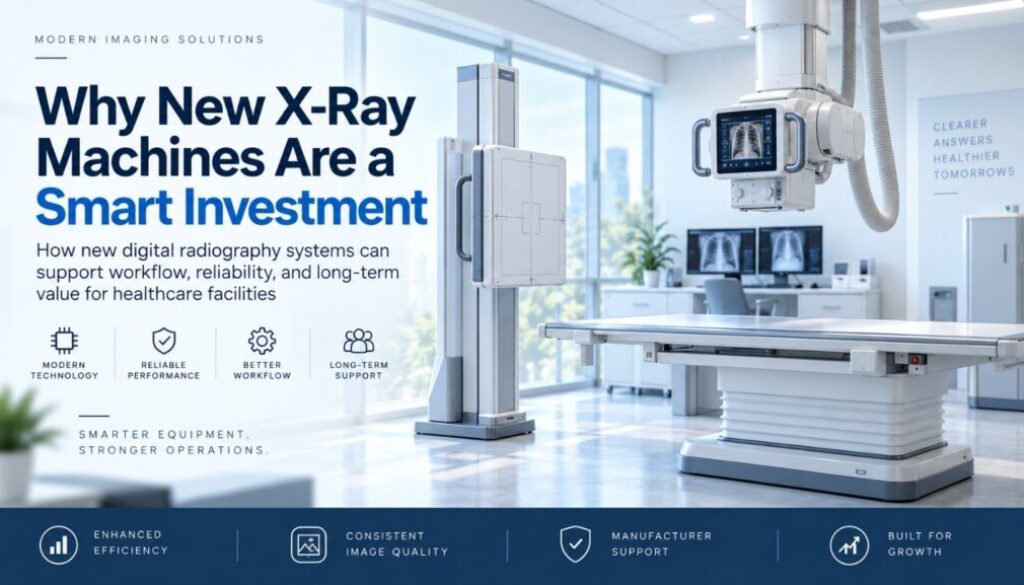
Why New X-Ray Machines Can Be a Smart Investment for Healthcare Facilities
For hospitals, imaging centers, orthopedic practices, urgent care facilities, physician offices, and other healthcare organizations, choosing the right X-ray equipment is an important clinical and financial decision.
Pre-owned imaging equipment can be an excellent solution for many organizations, particularly when budget and capital preservation are priorities. However, there are also situations where purchasing a new X-ray machine can provide significant long-term value.
New digital X-ray systems can offer healthcare facilities access to current imaging technology, modern workflow capabilities, manufacturer support, predictable equipment life, and potentially lower maintenance uncertainty during the early years of ownership.
The right decision ultimately depends on the facility’s patient volume, clinical requirements, budget, expected equipment utilization, and long-term plans.
Why X-Ray Imaging Remains Essential to Modern Healthcare
Radiography remains one of the most widely applicable forms of diagnostic medical imaging.
X-ray imaging allows healthcare professionals to visualize internal structures of the body and can assist in identifying disease, injuries, foreign objects, and structural abnormalities. Common applications include orthopedic examinations and many other diagnostic procedures.
Because X-ray imaging can be performed relatively quickly and is useful across numerous specialties, X-ray equipment can become an essential part of a facility’s daily clinical workflow.
Depending on the organization, digital radiography may support:
- Orthopedic evaluations
- Chest imaging
- General radiography
- Emergency medicine
- Urgent care
- Surgical planning
- Outpatient diagnostic imaging
- Chiropractic imaging
- Occupational health
- Specialty medical practices
For facilities performing a substantial number of radiographic examinations, the capabilities and reliability of the X-ray system can directly affect workflow and patient throughput.
Why Consider Purchasing a New X-Ray Machine?
Cost is naturally one of the first factors considered when purchasing medical imaging equipment.
A used or refurbished system will generally require less upfront capital than comparable new equipment. But acquisition price should not be the only factor in the decision.
Healthcare organizations should consider the total cost of ownership and the expected useful life of the system.
For some facilities, investing more upfront in new X-ray equipment may provide advantages in reliability, technology, support, workflow, and long-term planning.
Here are several reasons a new system may be worth considering.
1. Access to Current Digital Radiography Technology
Modern X-ray departments increasingly rely on digital radiography rather than traditional film-based imaging.
Digital radiography uses digital detectors to acquire X-ray images that can then be processed, transmitted, stored, displayed, and interpreted electronically. The American College of Radiology describes digital radiography as projection X-ray imaging using a digital X-ray detector and emphasizes the importance of digital data throughout acquisition, transmission, storage, display, interpretation, and consultation.
Purchasing a new digital X-ray system can give a healthcare facility access to a current-generation platform rather than adapting its workflow around older technology.
Depending on the system selected, newer equipment may provide improvements in areas such as:
- Detector technology
- Image processing
- User interfaces
- Workflow automation
- Exam setup
- Image transfer
- System integration
- Equipment ergonomics
The actual capabilities vary significantly between manufacturers and models, so facilities should compare equipment based on the examinations they perform rather than simply purchasing the newest platform available.
2. Longer Expected Equipment Lifecycle
One of the strongest arguments for purchasing new X-ray equipment is straightforward: the facility is beginning ownership at the start of the equipment’s lifecycle.
With used equipment, part of that lifecycle has already been consumed.
That does not necessarily make used equipment a poor investment. Well-maintained pre-owned systems can remain clinically valuable for years.
However, a facility intending to operate the same system for a long period may find the economics of purchasing new equipment more attractive.
For example, an organization planning to use the system heavily for the next decade may place greater value on:
- Long-term parts availability
- Manufacturer support
- Software availability
- Equipment longevity
- Upgrade options
- Serviceability
The longer the expected ownership period, the more important lifecycle planning becomes.
3. Greater Predictability in Maintenance
Every medical imaging system eventually requires preventive maintenance, service, and potentially component replacement.
The advantage of buying new is not that the equipment will never require service.
Instead, the facility begins with equipment that has not already accumulated years of clinical usage.
That can make maintenance planning more predictable, particularly during the earlier portion of the system’s life.
New equipment may also be sold with manufacturer warranty coverage or service arrangements depending on the purchase agreement.
For healthcare organizations where unexpected downtime can interrupt patient scheduling and revenue generation, that additional predictability may justify a higher initial investment.
4. Manufacturer Warranty and Support
Warranty coverage can be an important part of the financial equation when purchasing a new X-ray machine.
Depending on the manufacturer and purchase agreement, new equipment may include warranty protection covering certain components, labor, or service during an initial period.
This can reduce some of the uncertainty associated with unexpected equipment problems shortly after installation.
Facilities should carefully review:
- Warranty duration
- Covered components
- Labor coverage
- Response times
- Preventive maintenance
- Remote support
- Parts availability
- Service contract options
The least expensive purchase is not always the lowest-cost system to operate.
A system with reliable long-term support can sometimes produce greater value than a less expensive machine with limited service resources.
5. Modern Workflow Can Improve Efficiency
A major consideration when evaluating new digital X-ray equipment is workflow.
Radiology departments do not operate in isolation.
The X-ray system may need to communicate with a facility’s broader imaging and information infrastructure.
This can include systems such as:
- PACS
- RIS
- Electronic health records
- Worklists
- Image archives
- Diagnostic workstations
Digital image management is an important part of modern radiographic practice, and the ACR notes that acquisition, transmission, storage, display, interpretation, and consultation all involve digital data that can affect patient care.
When evaluating a new X-ray system, facilities should therefore look beyond image acquisition.
Workflow integration can be equally important.
Reducing unnecessary steps for technologists can potentially improve department efficiency and create a more streamlined experience for both staff and patients.
6. Better Alignment With High-Volume Facilities
The economics of new equipment can become particularly attractive when utilization is high.
Consider two hypothetical facilities.
One performs a relatively small number of X-rays each week.
The second operates a busy imaging department throughout the day.
Equipment uptime, workflow speed, and reliability may have dramatically different financial importance to those organizations.
For a high-volume facility, even relatively small workflow improvements can accumulate across hundreds or thousands of examinations.
A new digital radiography system may therefore make the most sense for organizations that expect to use the equipment extensively.
7. New Equipment Can Support Expansion
New X-ray machines can also make sense when a healthcare organization is building a new facility or expanding an existing location.
A facility starting from the ground up has an opportunity to design the imaging environment around the equipment rather than fitting equipment into an existing workflow.
This may include planning:
- Room dimensions
- Electrical requirements
- Equipment positioning
- Shielding
- Patient movement
- Technologist workflow
- PACS connectivity
- Workstations
- Accessibility
Planning equipment and facility infrastructure together can create a more cohesive radiology environment.
8. Radiation Dose Optimization Remains Important
Medical X-ray imaging uses ionizing radiation, so facilities must appropriately balance diagnostic benefit with radiation exposure.
The FDA states that clinically appropriate X-ray examinations generally provide benefits that outweigh the associated radiation risk, while emphasizing that unnecessary exposure should be minimized and equipment settings should follow the ALARA principle, meaning radiation exposure should be kept “as low as reasonably achievable.”
When evaluating new digital X-ray machines, healthcare organizations should therefore consider dose-management and exposure-control capabilities alongside image quality.
However, new equipment alone does not guarantee optimal radiation practices.
Proper protocols, trained personnel, equipment configuration, preventive maintenance, quality assurance, and appropriate clinical use remain essential.
9. Quality Control Still Matters With New Equipment
Purchasing a new X-ray system does not eliminate the need for quality control.
The American College of Radiology recommends continuous quality-control programs for radiographic equipment, with appropriate testing and involvement from qualified medical physics professionals.
Facilities should plan for:
- Acceptance testing
- Preventive maintenance
- Routine quality control
- Annual equipment evaluation when applicable
- Detector evaluation
- Exposure consistency
- Image quality monitoring
- Staff training
A high-quality X-ray machine still depends on a strong quality-management program.
10. New Equipment May Help Standardize Multiple Locations
Healthcare organizations operating several locations may also benefit from equipment standardization.
If each location uses completely different generations or manufacturers of X-ray equipment, technologists may have to adapt to different interfaces and workflows.
Selecting similar new systems across multiple facilities can potentially help standardize:
- Technologist workflows
- Training
- Protocol development
- Service procedures
- Equipment operation
- Image processing
- Parts and accessories
Standardization can become especially valuable as an organization expands.
New vs. Used X-Ray Equipment: Which Is Better?
There is no universal answer.
Both new and used X-ray machines can be excellent investments when properly matched to a facility’s needs.
A pre-owned system may make more sense when:
- Capital budget is limited
- Patient volume is lower
- The facility needs a secondary X-ray room
- The system will be used for relatively straightforward exams
- A well-maintained proven platform is available
- The organization wants to minimize initial investment
A new X-ray machine may make more sense when:
- Patient volume is high
- Equipment uptime is especially important
- The facility expects long-term ownership
- Current technology is a priority
- The facility wants manufacturer warranty coverage
- Integration with modern systems is important
- The organization is opening a new location
- Standardization across facilities is desirable
The smartest buying decision is not automatically “new” or “used.”
It is the system that provides the best combination of clinical capability, reliability, acquisition cost, operating cost, service support, and expected useful life.
What Should Facilities Consider Before Buying a New X-Ray Machine?
Before purchasing new medical X-ray equipment, healthcare organizations should establish clear requirements.
Important questions include:
What examinations will be performed?
A general radiography department may have different needs than an orthopedic practice or urgent care facility.
How many patients will use the equipment?
Higher utilization can make reliability and workflow efficiency significantly more important.
What type of detector configuration is required?
Facilities should evaluate detector size, number of detectors, portability, workflow, and replacement considerations.
How will the equipment integrate with existing systems?
PACS, RIS, worklists, archives, and other infrastructure should be considered before purchase.
What is included in the purchase price?
Installation, training, warranty, accessories, detectors, workstations, shipping, and service may not always be included in the headline equipment price.
What service support is available?
A technologically advanced machine provides limited value if qualified service cannot be obtained when needed.
How long will the facility keep the equipment?
Expected ownership period should play a major role in determining whether the additional cost of new equipment makes financial sense.
Look Beyond the Purchase Price
One of the biggest mistakes healthcare facilities can make is comparing X-ray systems based only on the equipment price.
A proper comparison should include the total investment.
That may involve:
- Equipment
- Shipping
- Installation
- Rigging
- Site preparation
- Electrical work
- Shielding
- Detectors
- Workstations
- Software
- Training
- Service contracts
- Preventive maintenance
- Future repairs
- Potential downtime
- Expected equipment lifespan
This creates a more realistic comparison between new and pre-owned systems.
A new X-ray machine may cost more initially but provide advantages over a longer ownership period.
Conversely, a high-quality used system may offer better economics when a facility does not require the newest technology.
The Right X-Ray System Is an Investment in the Facility
X-ray equipment is more than another piece of medical technology.
For facilities that depend heavily on diagnostic imaging, it becomes part of the organization’s daily clinical infrastructure.
Purchasing a new digital X-ray system can be an excellent option for healthcare organizations that value long-term equipment life, predictable support, modern digital workflows, current technology, and manufacturer-backed service options.
The goal should not be to purchase the most expensive machine or automatically choose the newest model.
Instead, facilities should identify the system that best fits their clinical volume, workflow, budget, space, staffing, and long-term business objectives.
For some organizations, that will be a high-quality used X-ray system.
For others, purchasing new equipment can provide the stronger long-term investment.
Working with an experienced medical imaging equipment provider can help a facility compare available options, understand installation and service requirements, and determine whether new or pre-owned X-ray equipment offers the best overall value.